Friday, December 2, 2011

Beyond Sustainability

TEDxHONOLULU - Matthew Lynch  

Beyond Sustainability: The Story of a Reformed Capitalist

Matthew is a reformed capitalist exploring Regenerative Design Sciences at the forefront of human innovation. He spent two years wandering the planet, in search of people, places, and projects working to make our world a better place. His work in Regenerative Agriculture, Regenerative Business, and Regenerative Economic Development has taken him (so far) to Australia, New Zealand, Mongolia, Germany, and now Hawai'i. Matthew is the author of Regenerative Business 1.0: Beyond Sustainability and founder of The Asia-Pacific Center for Regenerative Design.

Sunday, October 23, 2011

Maine Farmer Changing World

Jim Gerritsen, a Maine organic potato farmer with a decades-long record of community involvement and activism, has been named by the editors of Utne Reader to the magazine's 2011 list of "25 People Who Are Changing the World."

Gerritsen was selected for his ongoing work leading efforts by independent family farmers to protect themselves from the threat of Monsanto litigation related to the corporation's patents on genetically modified seeds, an effort he sees as critical to the preservation of organic farming itself and organic foods as a choice for consumers and their families.

Each year, Utne Reader selects 25 people "who possess an inspiring combination of imagination, determination and energy," said Utne Reader's editor-in-chief, David Schimke in a statement about the 25 visionaries. "These are people who don't just think out loud, but who walk their talk on a daily basis."

Gerritsen, who grows organic seed potatoes on his family's Wood Prairie Farm in northern Maine, is president

of the Organic Seed Growers and Trade Association (www.osgata.org), the national membership trade organization of the organic seed community, lead plaintiff in the OSGATA et al v. Monsanto lawsuit, which is currently in pre-trial procedural motions.

OSGATA is joined in the lawsuit by 82 other family farmers, seed businesses and agricultural organizations. The lawsuit asserts that Monsanto's patents on transgenic (gene-spliced) seed fail to meet the "social utility" requirement of patent law and are therefore invalid.

The suit also seeks court protection for innocent family farmers from Monsanto patent infringement lawsuits in the perverse situation where their farms are contaminated by Monsanto genes through unwanted genetic trespass, such as when wind-borne transgenic pollen is blown from one farm to another.

For 35 years, Gerritsen and his family have owned and operated the organic Wood Prairie Farm in Bridgewater, Maine. Located in Aroostook County, which is the top potato-producing county in the country, Wood Prairie Farm is a small certified organic family farm producing various types of seed and specialty potatoes, including the award-winning Prairie Blush variety discovered by the Gerritsens, plus vegetable and grain seed.

The farm's modest scale allows Gerritsen and his family to focus on growing high-quality seed potatoes for catalog customers in all 50 states.

Gerritsen is a tireless advocate for organic farming and family farms, regularly speaking at conferences and events, including the Maine Organic Farmers and Gardeners Association (MOFGA) Common Ground Country Fair and Farmer-to-Farmer Conference, The Organic Seed Growers Conference, the Slow Food Terra Madre Conference in Italy, and others across the United States and Canada.

In addition to Gerritsen, others on the Utne Reader Visionary List for 2011 include David Simon, creator of HBO's "The Wire" and "Treme"; Azzam Alwash, Nature Iraq founder and marshland rehabilitator; Rep. Keith Ellison (D-Minn.), a congressman working to foster dialogue between Muslim and Christian interests; Gary Paul Nabhan, an author called "the father of the local food movement"; Peter Beilenson, founder of the Evergreen Project in Baltimore and that city's former health commissioner; Debbie Sease, national campaign director of the Sierra Club; and Humira Saqeb, founder of a women's magazine in Afghanistan.

The full list and profiles of the 25 can be read at www.utne.com/Politics/25-visionaries-changing-your-world-2011.aspx.

Monday, October 17, 2011

Permaculture 2 : Practical Design for Town and Country in Permanent Agriculture


151 pages. by Bill Mollison 


Price:
$24.95

This book is about design.


It is a practical book dealing with the elements of design which create a sustainable system. Energy benefits are discussed relating to both domestic and broad acre environments.


Permaculture Two is about design, not gardening or livestock per se, but as elements in a system intended to serve man, and the ends of good ecology.


"Good teachers have nothing to give but enthusiasm to learn; they cannot with the best will in the world, give their students knowledge. Thus it is 'how' to design, rather than designing your site, which I am attempting here". - Bill Mollison 


Permaculture 2: Practical Design for Town and Country in Permanent Agriculture, by Bill Mollison

Saturday, October 8, 2011

Food Forest


Join Geoff Lawton on a Permaculture adventure as he demonstrates how to grow a food forest from start to finish. Over 90 minutes of quality information to get you on the right track in creating your own garden of Eden.

We start with a 20 minute Permaculture Classroom as Geoff explains the patterns of a Food Forest and the essential principles of "time stacking" your garden with the right mix of support species that feed and protect your fledgling fruit trees into maturity. We then join Geoff in the field as he puts the theory into action, planting the seeds and watching the system grow.

We end up at Tagari Farm - established by Permaculture founding father, Bill Mollision - which was abandoned years ago, but planted according to Permaculture design principles. Would this Food Foest survive on its own? You'll be surprised.

Elements covered in the DVD include:

  • Forest fundamentals
  • Legumes
  • Chop and Drop
  • Pests
  • Fungi
  • Using Chickens
  • Weeds
  • Nursery
  • Kitchen gardens
  • Swales
  • Hardwood
  • Mature systems
  • and much more...

Bonus features include:

  • 30 Year Old Food Forest
  • 300 Year Old Food Forest
  • 2000 Year Old Food Forest

Running Time: 85 minutes (not counting bonus features)


Friday, September 30, 2011

Capt. Charles Moore on the seas of plastic


http://www.ted.com/talks/capt_charles_moore_on_the_seas_of_plastic.html

Keyline Design at the Beach by Darren Doherty (videos)

Darren Doherty, principal of Australia Felix Permaculture, builds a scale model watershed to explain how water cycles through the landscape in a sequence of natural patterns.


Part One introduces the Order of Drainage and identifies the keypoint of a valley.


Part Two - effects of deforestation and hydroelectric dam siting - succession of ridges - keypoint ponds and irrigation of foothills


Part Three - saddle ponds and slope irrigation


Part Four - reforestation and restoring the landscape


Part Five - rainwater vs. groundwater - drought and fire proofing

Produced by Sustainable World Radio and Permaculture Podcast 

Friday, September 9, 2011

Whole Green Catalog: 1,000 Best Things for You and the Earth


Never have everyday choices carried more consequences than right now.

Think of the choices we can make—do make—every day as small steps, in either a positive or a negative direction. Each choice can work to benefit you, me, and our whole community—and ultimately, our global environment.
How can we make those right choices? One at a time, with the help of the Whole Green Catalog. We’ve convened thought leaders in every category—from home furnishings and appliances to clothing and children’s toys, from pets and beauty products to travel and investing— to share their authoritative tips, reviews, and advice. To share with you a wealth of green information and green ideas.
Just a few years ago, there were very few “green” products on store shelves and little or no “green” components in many of these categories; they simply didn’t exist or couldn’t compete in the marketplace. The sheer size of the Whole Green Catalog illustrates the diversity of possibility, discovery, and potential, answering such questions as: Can one go green and save money? Can people reduce their carbon footprint if they are business travelers? Is there an environmentally-friendly disposable diaper?
This catalog is a browser book. Like the original Whole Earth Catalog, which helped to define the credo of its age, this is a resource guide to a special kind of life: then, an alternative lifestyle and now, a sustainable one. It is designed for people to peruse, consult, find, and choose. And it is full of surprises and delights—on every page. Flip through, and you’ll find that it opens many doors.
Available @ Amazon, Barnes & Noble and other fine retailers

Saturday, April 30, 2011

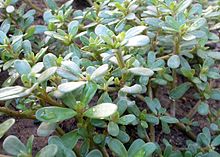
Purslane plant (Portulaca oleracea)


Purslane plant (Portulaca oleracea)

Purslane contains more omega-3 fatty acids (alpha-linolenic acid in particular) than any other leafy vegetableplant. Simopoulos states that Purslane has 0.01 mg/g of eicosapentaenoic acid (EPA). This is an extraordinary amount of EPA for land based vegetable sources. EPA is an Omega-3 fatty acid normally found mostly in fish, some algae and flax seeds.[5] It also contains vitamins (mainly vitamin Avitamin C, and some vitamin B andcarotenoids), as well as dietary minerals, such as magnesiumcalciumpotassium and iron. Also present are two types of betalain alkaloid pigments, the reddish betacyanins (visible in the coloration of the stems) and the yellow betaxanthins (noticeable in the flowers and in the slight yellowish cast of the leaves). Both of these pigment types are potent antioxidants and have been found to have antimutagenic properties in laboratory studies. 


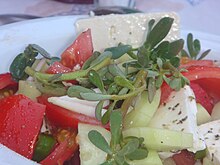
Greek salad with Purslane


Sunday, April 10, 2011

Permaculture in Humid Landscapes - Permaculture Design Course by Bill Mollison

The category we are in now is humid landscapes, which means a rainfall of more than 30 inches [T.F.: 760 mm]. Our thesis is the storage of this water on the landscape. The important part is that America is not doing it.

The humid landscape is water controlled, and unless it is an extremely new landscape -- volcanic or newly faulted -- it has softly rounded outlines. When you are walking up the valley, or walking on the ridge, observe that there is a rounded 'S' shaped profile to the hills.

Where the landscape turns from convex to concave occurs a critical point that we call a keypoint.[2]
The main valley is the main flow, with many little creeks entering. At the valley head where these creeks start, we locate the major keypoint. From there on, the keyline starts to fall from one in 1,000 to one in 2,000 below contour. The dams we make in the lower valleys will be slightly lower at each point. They will not be at the keypoint.

Rain falling on the hilltop runs off. The paths described by single raindrops, wherever they fall, are similar in that they cross contours at right angles, because that is the shortest drop between two contours. Water takes the shortest path across the landscape from where it falls to where it hits the river line. It is along this path that raindrops are doing their thing. As soon as they are in the river valley, they are off to the sea.

It is possible to locate the keypoint from a contour map. Find where the contours start to spread. That is the keypoint.[3]


Having found the keypoint, we can now treat the whole landscape as if it were a roof and a tank.

Having found the keypoint, we can now treat the whole landscape as if it were a roof and a tank. In a fairly descending line, falling gently away from the horizontal, we put in a groove around the hill. This is the highest point at which we can work with mechanical tools. Above that, it is too steep. We make a little shelf around the hill leading to the keypoint. No matter where this water was going, we have now started to divert it, bringing it right around the hill to the keypoint. In effect, we have put a gutter around our roof, a very gently falling gutter. We started at the key point and extended a line that we lifted one foot at every 2,000 feet. We want to create a very, very gentle fall. Water just moves along it, and that is all. We have directed the water to our keypoint.

Read more

Wednesday, March 30, 2011

Tampa Bay Living Green Expo at the St. Pete Coliseum – Sat. and Sun., April 2-3

The Tampa Bay Living Green Expois back in St. Pete once again, educating people through a variety of presentations and live panel discussions about green jobs, Florida native plant landscaping, local food, energy efficiency, and home energy retro-fitting.
Held this Saturday and Sunday, April 2-3, the expo is region’s best and largest showcase of sustainable products and services and provides real solutions for people to live better, healthier lives with less impact on the environment.

There will also be activities and crafts for the kids, food vendors with healthy options and an array of free informational sessions covering a range of green-related topics.
Mo Eppley, a board member of Tampa Bay Living Green, Inc. and President of MityMo Design, an event sponsor, knows that this event has a huge impact on Tampa Bay area businesses. “With our economy in recovery, even small changes can make a huge difference,” says Eppley. “Business owners tell us that they’ve improved their bottom line and saved on monthly energy costs by incorporating greener solutions.”
Steve Plice, Board President of Tampa Bay Living Green, Inc., knows that green living has helped Tampa Bay area residents as well. “Over the past 6 years, attendance has increased,” says Plice. “Year after year, people are coming back to the Expo… they tell us that they are going green because it is easy to do and affordable for working families.”
Check out the event’s website for a list of vendors, schedules and info session times. Admission and parking are free!


Saturday and Sunday, April 2-3; Sat.: 9 a.m.-5 p.m., Sun.: 10 a.m.-4 p.m. 535 4th Ave N, St. Pete.tampabaylivinggreenexpo.org
Founded in 2006, the Tampa Bay Living Green, Inc., a 501 (c)3 non-profit organization, is committed to providing real solutions for people to live better, healthier lives with less impact on the environment. The Expo is a collaborative effort organized by a steering committee with representatives from local government, schools and colleges, for-profit businesses, and non-profit organizations. Attendance for 2011 is expected to reach 5,000 people for the two-day event. Sponsors of the 2011 Tampa Bay Living Green Expo include Clear Channel Outdoor, Bright House Networks, Creative Loafing, WMNF 88.5, PSTA, The City of St. Petersburg, Pinellas County, University of South Florida- St. Petersburg, Bay Tech Label, MityMo Design, Think Video Studios, Southwest Florida Water Management District and Tampa Bay Water. The website can be found at www.tampabaylivingreenexpo.org.

Tampa Bay Living Green Expo at the St. Pete Coliseum – Sat. and Sun., April 2-3